 Those crazy Paraguayans, always jokesters
 The whole family goes to welcome the Canadians at the airport - Evelyn (the nanny), Janina's Dad and the Paraguayan Coordinator for Operation Christmas Child, Janina, Juan with Baby Nehemias, and me
 Juan and Nehemias
 Janina and Nehemias
 They Arrive
 The bus
On the ride back from Asuncion, I talked constantly. There was so much to tell about Paraguay, and they were so eager to learn. “How poor is poor?” they asked. “61% of families where we will be live on much less than $300 a month,” I explained. “Is there organized crime here?” they asked. “Just the government,” I answered. “Are you happy here?” they asked, just like all the Paraguayans do, too. “I love it here. Paraguayans are open and giving and loving, and they will share whatever they have when they hardly have anything, and they have been screwed over for their whole history, but you will never meet better people.” They nodded, pleased. They snapped photos right and left. Aw, I thought, I remember when I used to take pictures of cows.
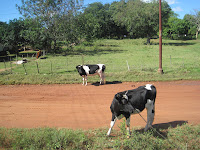 I took this 2 days into Paraguay
That week was a busy one, with 2 distribution sessions a day. Most of the boxes were anonymous, however many of the Canadians had packed their own special shoeboxes that they would personally give to a lucky, chosen child. It was mostly for this 15 minutes of bonding and photo ops that they wanted translators, although it is not easy to organize and give boxes to hundreds of kids at once, so Meli and I were all over the place.
After one distribution session, when we were back on the bus, one lady was tearfully telling the story of the little girl who’d received her gift box. “She said she comes from a very poor family,” she sobbed, “and that’s when I started crying.” This apparently hit her harder than expected because the crying didn’t stop for the next 2 hours. She wasn’t the only one, either. Meli and I rolled our eyes at each other. They ALL come from poor families, we thought. They wouldn’t BE here if they didn’t, as the whole goal of the organization is to give gifts to poor kids.
I kicked this idea around for the next couple days because something about it inherently bothered me. If I were Paraguayan, I thought, and some chuchi Canadian came to visit and then burst into tears at what to me was my completely normal life, would that be considered offensive? For an instant, I felt defensive. Who were they to momentarily fly in to these kids’ lives, with their khaki pants and their racking sobs? I tiptoed around the idea with Yanina, Juan’s wife, to see what she thought. “I think the Canadians are having a good trip,” I said, “But they sure do cry a lot.” “They’ve never seen poverty like this before,” she said, “It can be a shock the first time.”
Then I remembered this conversation I’d had with Paulette months ago, where she’d told me about how her biggest epiphany, the thing that really changed her the most since she’s been here, was realizing that Paraguayans are real people. “I know, I know,” she was quick to add, “I know exactly how bad that sounds, and it seems so obvious, but our whole lives we hear about people in other countries, and we don’t REALLY get it. And I remember when I realized, oh my God, they really are JUST like us. They joke and love and dream and are the same as us, and from there it’s not that big of a leap to see that we are the same all over the world. And we hear on the news about 10,000 people dying somewhere far away, and don’t necessarily think that these people had real lives, with families and friends and goals…but now I do.”
They were already very kind and sweet people when they got here, and they’d put in dozens and hundreds of hours of volunteer work, packing and shipping gift boxes all over the world. However, it is one thing to live a normal first-world life, think about the poor children in other countries, and want to help alleviate the idea of poverty, but it is another thing to see that poverty first-hand. It is another thing to talk to this tiny girl with big brown eyes and long lashes, whose hair is thin and patchy because of a skin fungus, and hear how her mom had abandoned her, but that the nice lady explaining things to your translator is taking care of her. It is another thing to pick a little girl out, at random, from among thousands, and learn that her name is Cinthia, which happens to be your own daughter’s name. What we saw was their epiphany moment of seeing how alike we are, and knowing that they will never look at the news the same way again. I am so grateful to have seen and been a part of that.
“I see why you love it here,” one lady told me after a few days. “Paraguay is wonderful. I’d come back tomorrow if I could.” “Yeah,” I grinned. They got it.


 Posts
Posts


Good report as always!!
ReplyDelete